


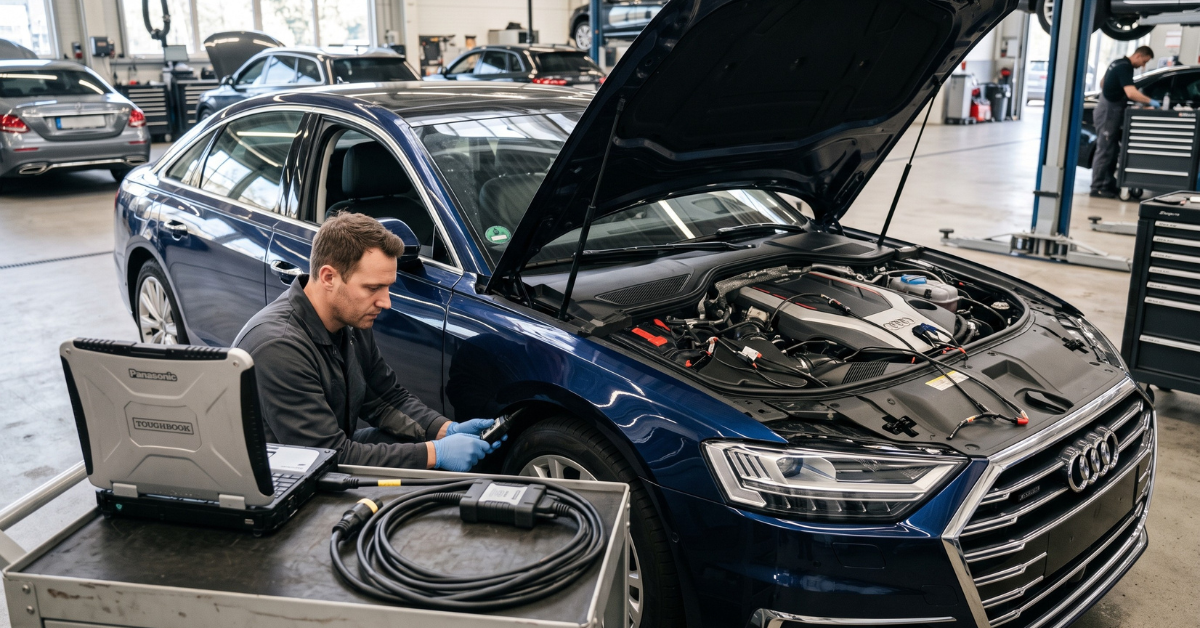
European cars are known for advanced engines, smart safety systems, and complex electronics. These features improve driving comfort and performance, but they also make fault-finding more difficult than it is on many basic vehicles.
BMW, Mercedes-Benz, Audi, and other European brands use brand-specific software and communication systems that generic scanners cannot fully access.
For drivers in Abu Dhabi, specialized diagnostic equipment is even more important. Extreme heat can place extra stress on sensors, wiring, cooling systems, and electronic modules.
A workshop with the right equipment can find faults more accurately, test individual components, and carry out coding or calibration when needed.
Reasons Your European Car Needs Specialized Diagnostic Equipment
1. European Cars Use Complex Electronic Systems
Modern European vehicles have many electronic control units, often called ECUs. Each unit controls a different part of the vehicle, such as the engine, transmission, air conditioning, airbags, suspension, lights, and driver assistance systems.
These units communicate through different vehicle networks, including CAN, LIN, and fiber-optic systems. A standard OBD-II scanner usually provides access to basic engine and emissions information. It may show an error code, but that code does not always reveal the real cause of the problem.
Specialized diagnostic equipment can communicate with more vehicle systems and provide technicians with deeper information for accurate testing.
2. Brand-Specific Software Provides Deeper Access
European car makers use their own diagnostic platforms and communication methods. BMW, for example, uses systems such as ISTA for detailed diagnostics and service functions.
Mercedes-Benz uses Xentry, while Volkswagen Group vehicles can use systems such as ODIS. These platforms are designed to communicate with the vehicle’s own control systems.
This deeper access can help technicians perform tasks that a generic scanner cannot handle. Depending on the vehicle and system, specialized equipment can help with:
- Reading detailed control module faults
- Checking live sensor information
- Performing system tests
- Registering replacement components
- Coding and programming modules
- Resetting service functions
- Carrying out certain software updates
3. Generic OBD-II Scanners Have Clear Limits
Generic scanners are still useful for basic checks, but they should not be treated as a complete diagnostic solution for a modern European vehicle. They are mainly designed around standard diagnostic functions and emissions-related information.
They may identify a fault code without giving the technician enough information to find the underlying problem. For example, a warning light could be caused by a sensor, wiring problem, control module, or another component.
Simply clearing the code does not repair the fault. Specialized equipment gives technicians access to more data and testing functions, which can reduce guesswork and prevent unnecessary part replacement.
4. Specialized Equipment Can Test Components Directly
One major advantage of advanced diagnostic equipment is bi-directional testing. Instead of only reading information from the vehicle, the technician can use suitable factory-level equipment to send commands to certain components and check how they respond.
This can be useful when diagnosing cooling fans, pumps, valves, fuel system components, and other electronically controlled parts.
For example, a technician may be able to activate a cooling fan through the diagnostic system and check whether it operates correctly. This type of testing can help separate a faulty component from a wiring or control problem.
5. Coding Is Important After Some Repairs
Some European vehicles need coding or registration after certain parts are replaced. A new battery is one common example on vehicles that use battery management systems. Depending on the model, the replacement battery may need to be registered so the vehicle’s charging system can manage it correctly.
Other components may also require coding, calibration, or programming after replacement. Without the right equipment, a technician may be unable to complete the process properly.
This is one reason a workshop should have more than a basic fault-code reader when working on modern European vehicles.
6. Abu Dhabi’s Heat Makes Accurate Diagnostics More Important
The hot climate in Abu Dhabi can increase stress on vehicle components. High temperatures can affect batteries, cooling systems, wiring, sensors, air-conditioning components, and electronic modules.
A fault that appears occasionally in mild conditions may become more noticeable when the vehicle is exposed to high heat. Advanced diagnostic tools can help technicians monitor live data and compare sensor readings with expected values.
This can make it easier to identify whether a problem comes from a failing sensor, wiring issue, cooling problem, or another component. Accurate testing is particularly useful when a vehicle has intermittent faults that are difficult to reproduce.
Also Read: PPC NBAD Balance Check
7. Cooling System Problems Need More Than a Visual Check
Cooling systems work hard in hot climates, especially when a European vehicle uses electronically controlled fans, pumps, or other advanced components. A visual inspection may show a leak, but it may not reveal an electrical or control problem.
Specialized diagnostic equipment can allow technicians to monitor coolant temperatures and other live readings. On supported vehicles, it can also perform actuation tests on cooling fans and pumps. This helps identify weak components before they cause overheating or leave the vehicle stranded.
8. ADAS Systems May Need Specialized Calibration
Many newer European vehicles use Advanced Driver Assistance Systems, including cameras, radar sensors, parking systems, and lane assistance features. These systems depend on accurate sensor readings and precise calibration.
A damaged bumper, windshield replacement, suspension repair, or sensor movement can sometimes affect calibration.
Specialized equipment can help technicians check and calibrate supported systems according to the vehicle’s required procedures. Generic OBD-II scanners generally do not provide the equipment or functions needed for these tasks.
Specialized Equipment vs. Generic OBD-II Scanners
| Diagnostic Feature | Specialized Equipment | Generic OBD-II Scanner |
| Basic fault codes | Yes | Yes |
| Engine data | Detailed | Basic |
| Access to multiple ECUs | Broad access | Limited |
| Live manufacturer data | Yes | Limited |
| Bi-directional testing | Available on supported systems | Usually limited |
| ECU coding | Yes, where supported | Generally no |
| Component registration | Yes, where supported | Generally no |
| Software programming | Supported on suitable systems | No |
| ADAS calibration support | Available with suitable equipment | No |
The exact functions available depend on the vehicle model, equipment, software version, and repair being performed.
How Specialized Diagnostics Can Prevent Unnecessary Repairs?
Accurate diagnostics can save money by helping technicians identify the actual source of a problem. Without proper testing, a workshop may replace a sensor simply because a related fault code appears.
If the real problem is damaged wiring or another control component, the warning may return after the repair. A detailed diagnostic process gives the technician more information before parts are ordered.
This can reduce trial-and-error repairs and help the owner understand what needs attention. It is especially valuable for European vehicles because many systems are closely connected and a single fault can trigger several warning messages.
Choose a Workshop With the Right Diagnostic Tools
The workshop you choose should have equipment suited to your vehicle’s brand and model. Ask whether the technicians use BMW-specific, Mercedes-specific, Audi-specific, or other manufacturer-level diagnostic systems when required.
It is also useful to ask whether they can perform coding, programming, component registration, and calibration.
If you own a BMW and need professional diagnostics or repairs, Exotic Auto Services can be considered when looking for a BMW workshop in Abu Dhabi.
Before approving any work, ask the technician what diagnostic equipment will be used and whether the inspection will include a detailed report of the faults found.
Conclusion
European vehicles need specialized diagnostic equipment because their electronic systems are more complex than the basic systems supported by generic scanners.
Factory-level or professional brand-specific tools can provide deeper access, live data, component testing, coding, programming, and calibration functions.
For drivers in Abu Dhabi, accurate diagnostics are particularly useful because high temperatures can add stress to cooling and electronic systems.
Choosing a workshop with the right equipment and trained technicians can help find faults sooner, reduce unnecessary repairs, and keep advanced European vehicles working as intended.